No Giggling matter
In which we channel the Southern sheriff from “Cool Hand Luke”

Back in the day, when e-mail listservs were the only social media game in town, I got kicked off a delightful lesbian listserv because someone else was flaming me relentlessly. I had noted Democrats in Congress voting against a Born Alive Infant Protection Act (and I approved of that Act), and mentioned what bad PR that was for the pro-choice side. This non-partisan analysis struck one woman as a great sin, and she began hounding me. Eventually, the admin decided to remove the headaches the flaming made for her by simply washing her hands of the both of us.
As you’re probably aware, Queensland’s federal court ruled again against Sall Grover and her Giggle for Girls social media app, and in favor of Roxanne Tickle. Were it a simple, straightforward ruling that Tickle has a right to subscribe to Giggle because she has had genital surgery and, in its wake, a birth certificate with an F marker (thus my use of the feminine pronoun here), it would be legally correct. There was more to it, including that Grover had committed anti-transgender discrimination against Tickle by using her appearance, both via facial recognition software and her own viewing, to say she was ineligible to participate. That was illegal, said the Court, because looking like a man is a protected characteristic of transwomen.
I’m sorry, but I got nothin’. All my snark and sarcasm reflexes have gone TILT at that (and I am farklempt!).
Before a Commission hearing, “The Sex Discrimination Commission was arguing that men who claim to be women could be perceived as pregnant and therefore they need pregnancy protections, and because they need legal pregnancy protections, that is enough for them to be considered women in law. That’s their argument.”
I got nothin’ there, either … just a red mark from another facepalm.
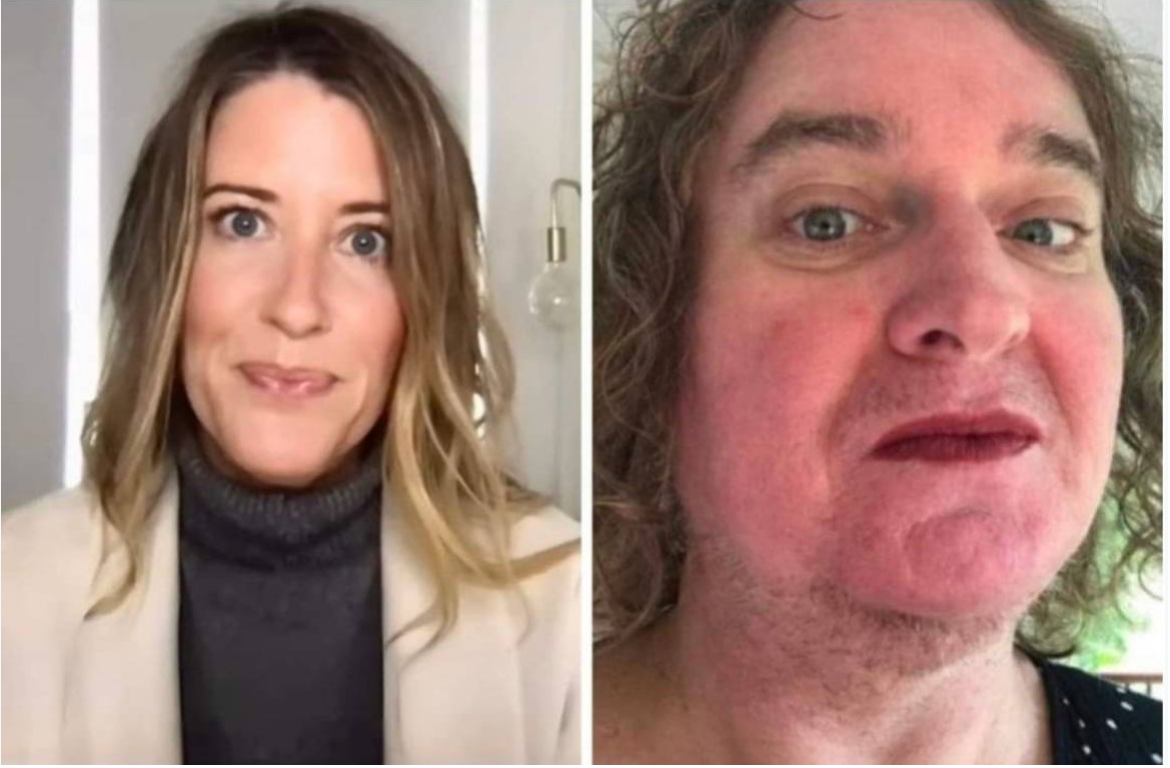
Grover and Tickle … and that’s a more flattering picture of the latter
Sall Grover is going to appeal to the High Court of Australia. One of her arguments will be that the Queensland federal court refused to consider the Giggle app as a lawful “special measure” under the Sex Discrimination Act, which explicitly permits sex-based measures (here, original sex-based measures) where they are necessary to promote women’s safety, equality, and dignity.
That’s key. The thing is, there’s nothing straightforward about transition and belonging among women, particularly when it involves midlife transitioners like Roxanne Tickle. It’s organic women, those born and grown up female, who are the ultimate judges of whether someone who’s transitioned to womanhood belongs among them. And the brain’s pattern recognition reflex is strong in organic women. It has to be, for women’s safety. Midlife transitioners are burdened with years of physical masculinization, not to mention the personality effects of years of living with male privilege. (See, e.g., Richard/Rachel Levine, foisted upon us by the Biden Administration.)
In Roxanne Tickle’s case, I’m going to paraphrase the Southern sheriff in the Paul Newman movie “Cool Hand Luke”: What we have here is a failure to assimilate.
Tickle has, according to the flurry of social media postings by Aussies, a social network, including a hockey team, that accepts her as a woman and in which she is liked. An inability to join Giggle should be no skin off her behind. Even if it made sense to challenge Giggle’s definition of female and its policies around that, Tickle is simply the wrong person at the wrong time. The wrong person, because she looks like a man in a dress. The wrong time, because trans-identified males are relentlessly invading women’s and girls’ domains (see, e.g., the recent California girls’ track finals).
Roxanne Tickle should have taken the L and accepted her outsider status gracefully. Now, she will be a figure of animosity and ridicule.
Moreover, she may have handed Australians a reversion of their sex discrimination laws to remove the inclusion of gender identity with sex, and making “sex” include identity, appearance, and mannerisms—you know, the bullcrap we Americans have been dodging with the repeated failure in Congress of the so-called “Equality Act.” From 1984 until 2013 the Act did have a clear, biological definition: “woman means a member of the female sex irrespective of age.” Then a Labour government got ahold of it. Australia may end up like the U.K., with a legal definition of sex = biological sex = physical sex at birth. U.K. Gender Recognition Certificates are still valid, but they do not confer the right to enter women’s private spaces and female-only groups, nor use of anti-sex discrimination laws.
As a result, honest early-onset gender dysphoria transsexual women will lose some of their rights, such as my having lost my participation in that lesbian listserv, because someone else was the A (per the AITA? Thing). (I hear rumblings of accepting that as the cost of burning everything down and starting over.)
I would not be a fan of an argument that, were Tickle really a woman, she would have said she wasn’t one for the purposes of joining Giggle, and gone away. Bowed out gracefully, yes. But, that argument has a long and sordid history.
The agitation for what were once called “woman-born woman” spaces evolved over time. Early on, post-Stonewall, the number of transsexual women in women’s groups was minute, and happened with the approval of the other women. There was a social trust situation. Small groups in which everyone is known to each other, directly or within a degree or two, are high social trust. I once read (and of course I can’t find it again) that towns of up to 1,000 enjoyed social trust cohesion.
This was long before the cosplayers started getting full of themselves.
When someone objected to someone’s inclusion, it was usually an outsider looking to exploit an emergent small group for their own purposes. They would say, “If you really were a woman, you would understand that you don’t belong,” even when everyone who welcomed her thought she belonged. This was part and parcel of the “political lesbian” (by political identity only) trying to make a lesbian group about leftist politics rather than mutual lesbian support and socialization.
As a “women’s community” grew, expanded, and networked, there was the WBW-only policy of the Michigan Womyn’s Music Festival. That may have been a byproduct of the desire to have a community and culture by women and free of non-female influences (which included rock ‘n’ roll). That resulted in a (post-op) transsexual woman getting ejected in the middle of the night one year. The next year, various people organized a “Camp Trans” informational picket outside the gates. A woman went in and did a survey, finding that 75-80% of Festies were fine with a post-op transsexual woman running around naked alongside them.
This, however, was at the cusp of the postmodern Gender Theory age. The next year, a more radical group organized their own Camp Trans and questioned the very need for “women’s space.” A group got inside and very visibly dropped trou—and that group included twig and berries people. Things went downhill from there, with the pro-trans side beginning to engage in aggressive actions that involved vandalism and intimidation.
Nice going.
Fast-forward to a couple of years ago, when London lesbian Jenny Murphy began doing speed dating nights in pubs. When she began excluding trans-identified intact males, the latter took to intimidating pub owners into non-platforming Murphy. She eventually got reinstated in one pub, but decided to start a private social club called L Community. Joining requires passing a facial recognition software test. Murphy has been doing fundraising in hopes of L Community being able to buy its own center (excuse me, centre). By all accounts, the gals are feeling safe and having great fun. And more power to them.
It seems to me that Sall Grover is simply doing what the times demand to keep her Gigglers safe and happy … here in a two-factor authentication age. I do hope she prevails.
Obviously, the war has reached a critical stage between Atlantis and Mu.